
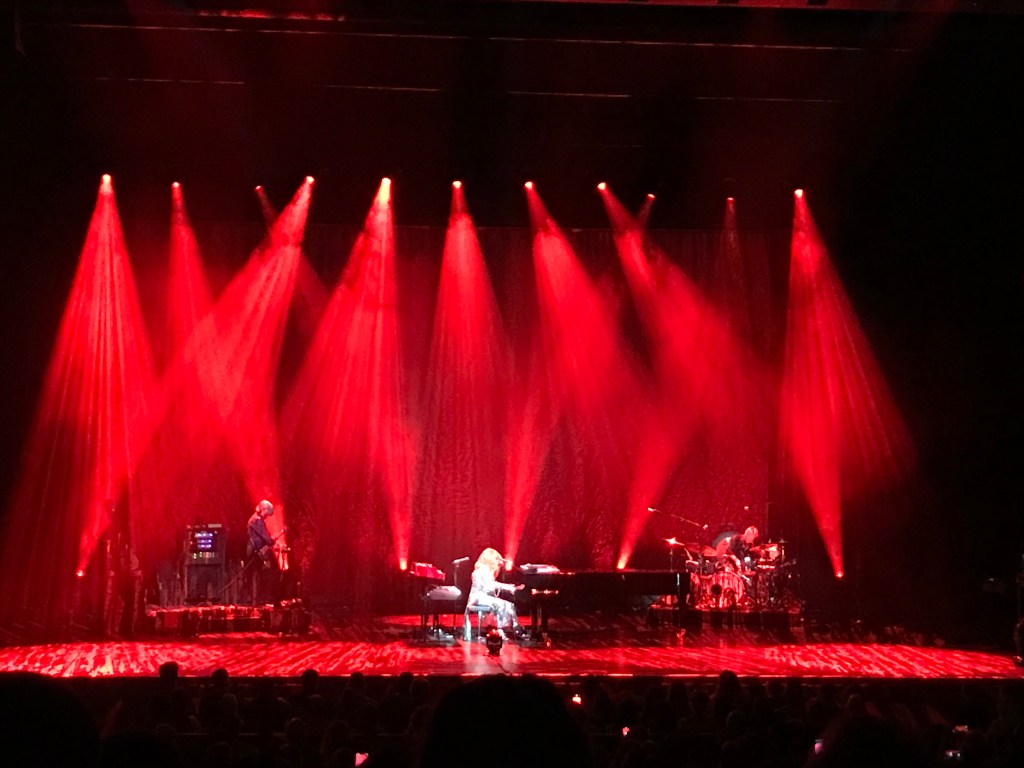
Tori Amos told The Guardian back in 2015 that straight men are tortured by her live shows due to the raw nature of her material, but I walked into the Artpark Mainstage Theater last night with no trepidation whatsoever. I didn’t have a “bowling ball in my stomach” or a “desert in my mouth.” Whether her contention was meant to be tongue-in-cheek didn’t matter, because her challenge was accepted, and, if obsessing about songs that encourage individuality and challenge social mores is supposed to be punishment, then sign me up for The Gulag.
Had I listened to her in the ’90s, I would have been too young to grasp the gravity of songs such as “Cornflake Girl” and “Me and a Gun,” so the fact that I got pulled into her musical universe in 2016 at the age of 28 meant that I was ready to confront the same uncomfortable truths she had been exposing since “Little Earthquakes” dropped in 1991. She was unlike anything else I had heard before and the idea that I didn’t fit the profile of what a typical fan of hers looked like didn’t matter to me.
Amos hit the stage around 9:00 p.m. and her trusty Bösendorfer was put to the test on “God,” “Ocean to Ocean,” and “Mrs. Jesus.” Each song received the live treatment with intoxicating dramatic swells that were rounded out by bassist/guitarist Jon Evans and drummer Ash Soan, both of whom elevated the overall atmosphere to the extent that I couldn’t envision this stuff being performed any other way.
As for Amos, her playing was ferocious throughout and her voice sounded every bit as majestic as I hoped it would. She hit her stride during the harrowing trifecta of “Silent All These Years,” “Swim to New York State,” and “I Can’t See New York,” the last of which shocked the system just as sharply as it did back in the years immediately following 9/11. I’m also convinced that her sultry howl on “Precious Things” is still echoing through the bowels of the Niagara River Gorge as I write this.
Ultimately, Amos’s oeuvre strikes the ideal balance between what those in the German educational system refer to as Wissenschaft (book learning) and Kenntnis (experiential learning). She began studying classical piano at the Peabody Institute when she was five before honing her skills on the bar scene at 13, so I’ve always felt that her work possesses a certain gravitas that many of her contemporaries just didn’t have. Her music is like life: complex, confessional, and confounding, often all within the same album cycle.
Her performance in Lewiston was one that I won’t shake off anytime soon and served as a reminder that, no matter how messy life becomes, we’ll always have artists like her to help get us through to the other side.

 Music N' Other Drugs
Leave a comment