

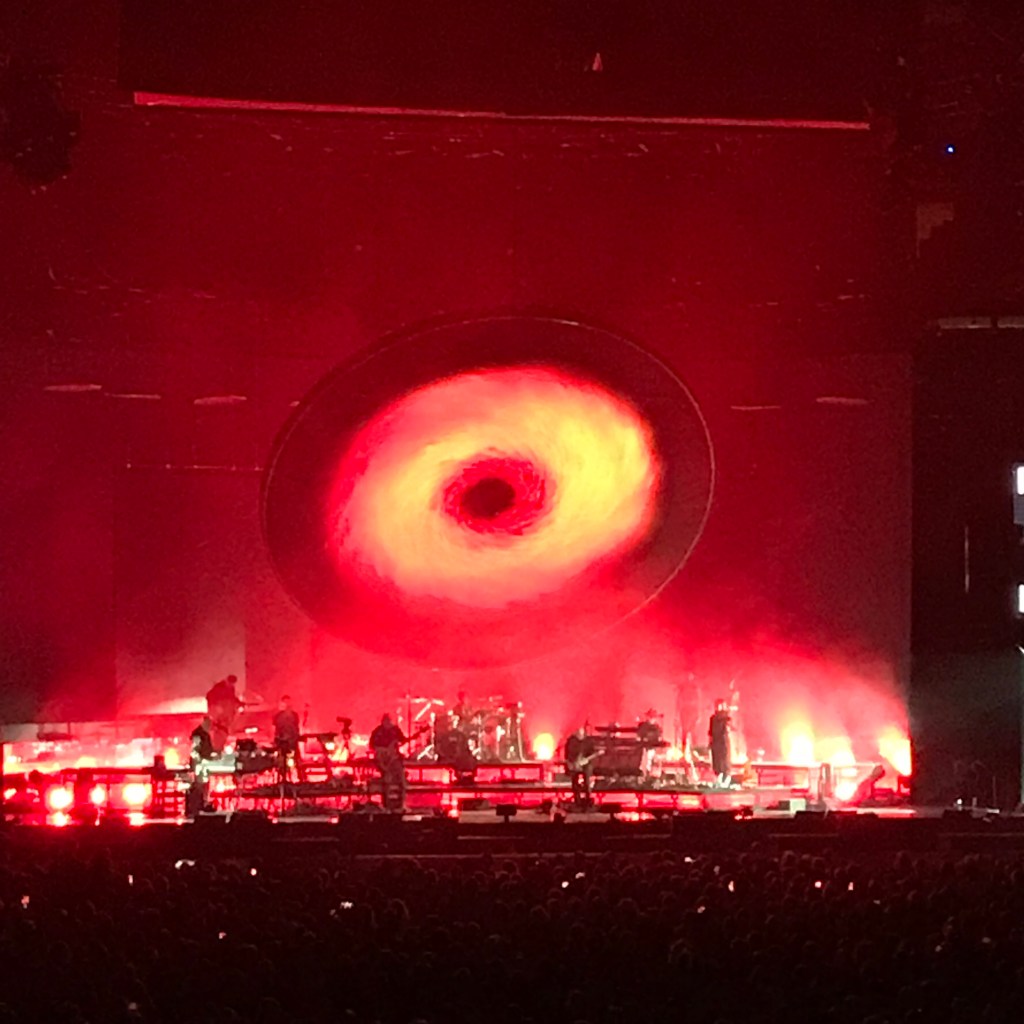
When Utilitarian philosopher Jeremy Bentham introduced the concept of The Panopticon in 1785, he likely didn’t foresee anyone re-purposing his idea 238 years later within the confines of a hockey arena. After all, no one outside of academia and the field of criminal justice is walking around with that information on the tip of their tongue, so Peter Gabriel’s inclusion of it is just one example of why Friday night’s show inside KeyBank Center was anything but a standard performance. The three-hour show was essentially a treatise on the perils of AI, universal surveillance, and environmental degradation masquerading as a big-budget art rock installation.
Why anyone would be surprised or disappointed by this is baffling, because Gabriel has been subverting expectations from the moment he walked “right out of the machinery” back in 1975. He’s not interested in rehashing the past and will play the hits when they happen to fit into whatever narrative he’s pushing at that point in time. He’ll give you what you want if and only if you’re willing to follow him on a brief journey through the history of time and space, which, if you call yourself a fan, is exactly the way it should be.
I heard a lot of babbling in my section about Set 1 testing everyone’s patience, but the argument that the lack of a physical release of “i/o” prevented people from digesting its brilliance is flawed. This material has been readily available on YouTube and various streaming services for months, so there’s no excuse as to why someone couldn’t have taken the plunge beforehand.
“Panopticom,” “Four Kinds of Horses,” and “i/o” were each stunning in their presentation, as Gabriel led his band to one ambitious height after another without fail. His voice was powerful, and the intuitive relationship he has with bassist Tony Levin, guitarist David Rhodes, and drummer Manu Katché after all these years is poetry in motion. Their collective chemistry took center stage during an ominous “Digging in the Dirt” in which Rhodes’s high-pitched distortion ricocheted off the walls and straight into my soul. The arrival of “Sledgehammer” just before the intermission was akin to a dog whistle for fans who couldn’t have cared less about the previous nine songs, because the execution was tight and the ovation was deafening in return.
Set 2 was cellist Ayanna Witter-Johnson’s time to shine as she and Gabriel took the audience on an evocative spin through “Don’t Give Up” that made my heart go boom, boom, boom on more than one occasion. While there can be only one Kate Bush, Witter-Johnson did a damn fine job of asserting herself on stage. Other highlights included the fiery attitude of “The Court” and the ethereal swoon of “Love Can Heal,” which was reminiscent of something that Julee Cruise would have sung on Twin Peaks.
Gabriel kept a deliberate pace throughout and ultimately rewarded the casual fans by serving up one of the finest finishes to any concert you’ll ever see with “Solsbury Hill,” “In Your Eyes,” and “Biko” in succession. 37 years had passed since he last played our area, but I left this show feeling as if he did everything he could to make up for lost time. The sights, the sounds, and the messages were life-affirming in a way that few events aspire to be anymore.
Just as people say that we need to appreciate our loved ones while we can, we also need to value our artists while they’re still capable of creating at a high level, because the world will feel a little bit colder once Peter Gabriel is no longer around to keep us warm.


 Music N' Other Drugs
Leave a comment