
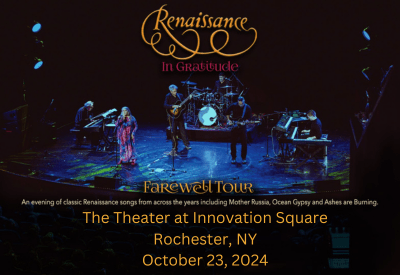
From the moment I heard Renaissance’s 1978 album, “A Song for All Seasons,” as a 15-year-old in 2003, I knew that they were a band immune to classification. Their unique blend of prog, folk, and orchestral elements was captivating, but the front-and-center mystique of Annie Haslam’s five-octave vocal range is what truly separated them from the other bands I was listening to. I had gotten a vinyl copy of her 1977 solo debut, “Annie in Wonderland,” by chance the year before and loved it, so I made a point of immersing myself in the rest of her stuff while my peers were reveling in the rhymes of Eminem and 50 Cent.
As Haslam told me in an interview earlier this week, the beauty of that catalog will live on long after the band ceases to exist in a touring capacity. She persevered in the wake of guitarist Michael Dunford’s death in 2012 and guided the band through an era that saw a slew of top-shelf live releases. She’s sad to see it end, but something tells me that she’ll be just fine given how passionate she is about her calling as an intuitive visual artist.
If you’ve never experienced Renaissance live before or want to hear classics such as “Ashes are Burning” and “Mother Russia” performed one last time, make the trek to Rochester on Oct. 23 and bask in the brilliance of a band that deserves to go out on its own terms.
MNOD: Your upcoming tour is billed as the “In Gratitude” Farewell Tour. Why did now feel like the right time to say goodbye?
Haslam: I’m going to be 78 and the responsibilities become greater the older you get. I took on more responsibility when the band carried on after the death of Michael Dunford in 2012, but it’s a lot. I’m pretty strong and my voice is still here, but the pandemic made everything more difficult in terms of touring costs. The prices have gotten beyond our reach. We had a great run, but it almost feels like it’s time to put it to bed. That sounds terrible to say. However, I’m proud of what we did and how unique we were as a band. When you’re young, you don’t think about how it can be gone in a heartbeat. Even though we’re not touring anymore, the music we made will always be there for everyone.
MNOD: I actually came to the Renaissance catalog after hearing your 1977 solo debut, “Annie in Wonderland,” a while back, so it was interesting to hear the stylistic differences between the two. How do you look back on that album today?
Haslam: That’s the best one. An incredible album and experience I’ll never forget. Getting to meet Paul McCartney was amazing. I feel as if I was let free, because Roy (Wood) was just brilliant in terms of what he was coming up with and I was able to do some different things. People always say that you don’t want to mix business and pleasure, because couples often have trouble. We didn’t have that issue, though. It was a great time. Have you gone back to hear all of the Renaissance albums?
MNOD: Yes, I think “A Song for All Seasons” is my favorite at the moment.
Haslam: You know, that’s also Mikael Åkerfeldt’s favorite. He’s a big fan of ours and I remember going to see Opeth when he introduced ‘Blackwater Park’ by dedicating it to me. The stage was a set up like a forest, and it was amazing to see. Then, he started with the growling, and I was like Oh! I do love the title track to ‘A Song for All Seasons’ and the way it grows all the way through. Terry Sullivan’s writing was tremendous.
MNOD: One album that I wanted to ask you about was ‘Timeline,’ because the band broke up shortly after its release. While it’s a departure from the classic sound in many ways, some of the songs have actually grown on me. Has your opinion of that time softened at all?
Haslam: No. I never wrote anything, so I just followed what they wanted to do. My thought was ‘Why are we changing to something that everyone else can do?’ The magic was gone. The same thing with ‘Camera Camera,’ although some of the songs are good. That was our demise.
MNOD: When Michael died in 2012, did you have any apprehension about continuing on?
Haslam: Not at all. We weren’t finished and couldn’t just stop honoring our commitments. We went to Brazil, Israel, Japan, Portugal, and Holland. We did ‘Cruise to the Edge.’ We did Justin Hayward’s cruise in 2020. One of things about touring now is how difficult it is going from one country to another, but continuing on with the band since then has been a fantastic experience.
MNOD: You mentioned that your voice is still here, so I’m assuming that fans will hear the songs performed just as they remember them?
Haslam: My voice never dropped. I still have all five octaves. We haven’t chosen what we’re going to play yet, but we’re working that out. ‘Northern Lights’ should be back. We’re also looking at some larger pieces, but those can be hard when we only have around two hours to play.
MNOD: If this is really it for the band, what are your plans once the tour is over?
Haslam: I’ll be concentrating on my art. I opened for Rick Wakeman a while back as a solo artist and that was wonderful, so there could be opportunities for stuff like that in the future. When John Wetton passed away, Geoff Downes asked me to sing on ‘In the End’ and that was such a gorgeous song. John was in a bad state with alcoholism for a while, but I was finally able to get him into rehab after two trips to England. I then came over for the memorial concert they had for him and that was such a powerful experience. I think that joining someone else here and there could be something that I could do going forward. It’s scary to end the band, but I have a lot to focus on.
MNOD: Does your art provide you with a similar creative outlet that the music does?
Haslam: I never read or wrote music, so I knew that I couldn’t teach it. I considered getting into photography for a time, but oil painting became my focus. I turned my sunroom into a studio. I’m not a reader, so, when I got a book about oil painting, I only made it through one page before I decided to just learn on my own. I think that’s how people do things. You make mistakes and learn from them. It came to me as a surprise, really. I paint plants, aliens, guitars, drumheads, and even violins. I don’t have any preconceived ideas. When a client asks me to paint a song, I ask how they feel when they hear the song and I paint their feelings. People have said that I have synesthesia, which could be true. I tune into things and do my best work when I have nothing else on my mind. It’s a completely different outlet, because music is about connecting to people and my art is about connecting to the Earth. When I perform, it’s more than just the music. It’s about the happiness and joy that I bring to the songs. People used to comment on how much I laughed on stage with Renaissance, but that’s something that people take with them after the show. It’s a soul connection. I want them to feel good.
MNOD: Thanks again for your time. I’ve never seen you live before, so I’m looking forward to the upcoming show in Rochester.
Haslam: We’re looking forward to it. If I had more time and money, I would go to each venue and take a video where I discuss its history. Every venue has a backstory, so it would be cool to promote each show by sitting in the venue ahead of time, but that’s too expensive.
Renaissance plays The Theater at Innovation Square in Rochester, NY on Oct. 23
See The Theater at Innovation Square | Rochester, NY (theaterais.com) or Renaissance (renaissancetouring.com) for details.


 Music N' Other Drugs
Leave a comment