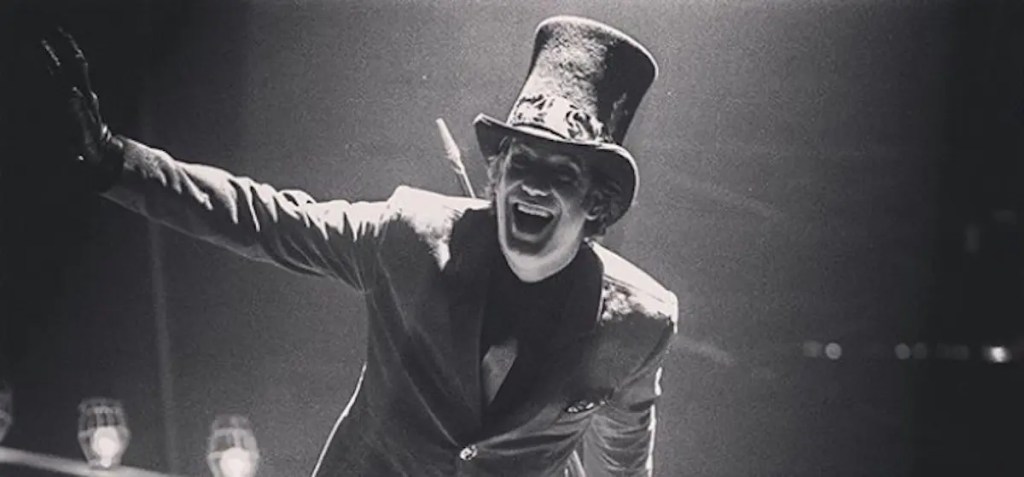
Nickelodeon’s 2019 reboot of “Are You Afraid of the Dark?” featured a character whose ability to make people see what he wanted them to see set the table for a series of insidious events that would unfold throughout the season. Mr. Tophat and his catch phrase, “It’s All Part of the Show,” have been rattling around in my brain way too much lately, as the sense that we’re all being dragged down the primrose path by the corporate media has never been more obvious.
I saw it when George Clooney flexed his Hollywood muscle to nudge Joe Biden not-so-subtly out of the hot seat. I saw it when Kamala Harris was framed as a tenacious middle-class upstart trying to make history by defeating the American equivalent of Pol Pot. And I saw it when David Muir and Linsey Davis cosplayed as objective journalists at the last presidential debate.
Candidates playing loose with the facts during a debate is nothing new, but it’s hard to have faith in the system when only one of them is being pressed or fact-checked in real time. We all know that Trump is his own worst enemy in terms of his ego and inability to stick to the issues, so, if the goal of ABC Snooze was to bait him into saying stupid things while never having to articulate what Harris actually plans to do for us, mission accomplished.
George Carlin might say “It’s all bullshit, and it’s bad for ya,” but Mr. Tophat would simply tell you that “It’s All Part of the Show.”
Harris set the tone for the evening when she failed to answer a direct question regarding whether or not she believes that people are better off than they were four years ago, but her deflection didn’t matter once everyone became fixated on a phantom claim that household pets are being devoured for dinner.
Why did that become the main talking point coming out of the debate?
Because, again, “It’s All Part of the Show.”
If Joy Reid, Rachel Maddow, and Morning Joe spent as much time trying to decipher what Harris’ “Opportunity Economy” is going to look like as they do bludgeoning the electorate with the horrors of “Project 2025” or treating the glorified buffoonery of Jan. 6 as if it were Pearl Harbor, perhaps we’d be getting somewhere. But they’re not interested in that. They’d rather blame the boogeyman for everything than acknowledge the fact that the Democrats have controlled The White House for 12 out of the last 16 years.
Longtime readers of this site or my work in general should be aware by now that I’m not afraid to call things out regardless of affiliation, because I stand on values that are more important to me than identity politics. I had a Hollywood Blvd. sign above my bedroom door well into my teenage years, bought into the initial Obama buzz in 2008, and was a fervent supporter of the movie industry as a whole until I realized how insulated from reality they had become. What used to be about bringing people from all of walks of life together in the name of entertainment mutated into virtue-signaling and an open discussion of whether or not those on the other side need to be re-educated through labor.
In her 1988 book, “Policy Paradox: The Art of Political Decision Making,” Deborah Stone argued that “if politicians can attain their objectives by portraying themselves as having attained them, then they should be studying portraiture, not cost-benefit analysis,” which is exactly where we find ourselves in 2024. Both parties are more concerned with being perceived as having achieved what they claim to have achieved than actually demonstrating tangible results at this stage of the game. Politics has become the new religion in America, and, regardless of who wins in November, we lose.
That said, what I really wanted to focus on here is my lifelong fascination with the American political machine despite my growing distaste for it. In the age of social media, it’s hard to envision any single advertisement altering the course of a campaign, but I’ve culled through 72 years of television history to find 10 commercials that I consider to be the most consequential of the bunch. As Roger Ailes once said, “Television is no gimmick, and nobody will ever be elected to major office again without presenting themselves well on it.”
In other words, “It’s All Part of the Show.”
“Daisy” Ad from 1964
The failures of LBJ would come later, but Goldwater’s goose was cooked the moment that the opposition was able to equate a vote for him with nuclear holocaust. Its impact is likely even greater for inspiring attack ads to go even further in future campaigns.
“Willie Horton” Ad from 1988
Once upon a time, being positioned as soft on crime was a bad thing and Dukakis found out the hard way.
“Swiftboat Veterans For Truth” Ad from 2004
Had I been old enough to vote in 2004, Kerry would have had my support despite this shameless attempt to smear his record in Vietnam that has since been discredited.
“Perot For President” from 1992
Perot snagged 18.9% of the popular vote during his first run, because people were truly souring on the two-party system.
“Signs of Hope and Change” from 2008
The seeds of Obama’s deification were planted here, as every frame of this spot is oozing with idealism and the feeling that America was on the precipice of something major.
“Kennedy For Me” from 1960
Americans have romanticized the Kennedys for generations and the purity of this old-school spot shows why.
“I Like Ike” from 1952
Eisenhower warned us about the dangers of the military-industrial complex on his way out, but, first, there was this catchy jingle.
“It’s Morning Again in America” from 1984
Mondale never stood a chance, but, honestly, no one else would have either at that time.
“Clinton For President” from 1992
Clinton’s origins are condensed into a 60-second spot that frames him as a quintessential American success story.
“Crime” from 1968
Nixon’s team laid the drama on thick and fear proved to be a hell of a drug.

 Music N' Other Drugs
Leave a comment