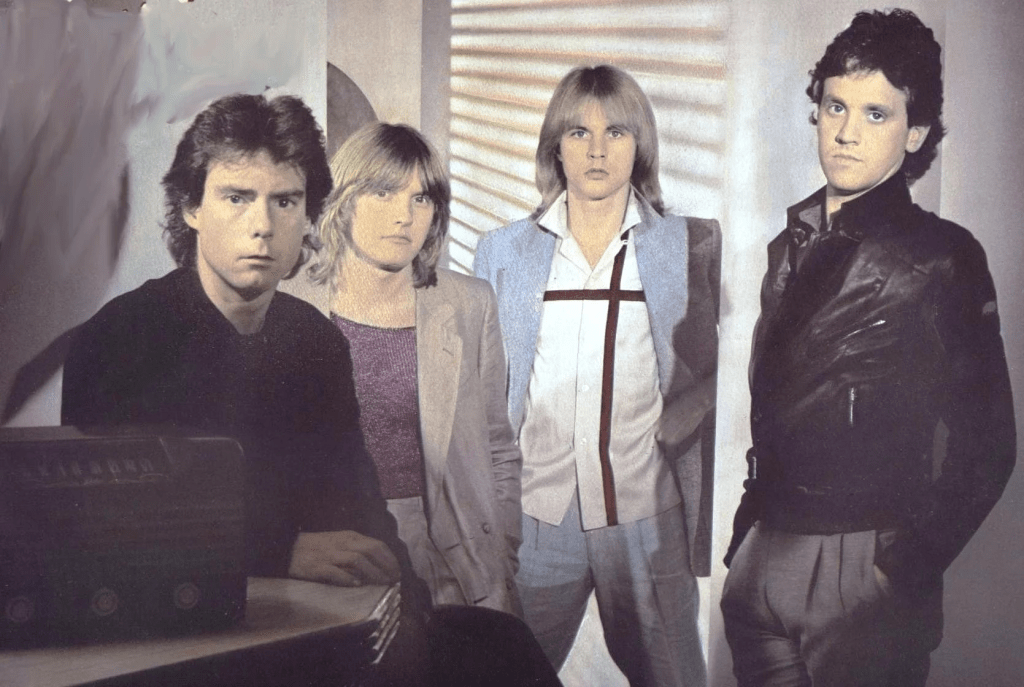

Having instant access to more content than ever before has its pros and cons, but, in the case of a band like Novo Combo, being able to consume every song at the click of a button is certainly an asset. Like so many short-lived groups whose material got lost in the shuffle once their members moved on to other things, they deserve a fresh look and the new release “45 West 55th” couldn’t be arriving at a better time.
Both the 1981 debut and its 1982 follow-up, “The Animation Generation,” feature buoyant power pop hooks bolstered by top-shelf musicianship that was perhaps too good for the waters they were swimming in. If you peruse the list of what these guys did before and after, you’ll see that there were and still are plenty of chops behind those new wave fashion choices.
Drummer Michael Shrieve, for instance, is in a much heavier artistic space these days as evidenced by his “Drums of Compassion” project that dropped earlier this year, but he still carved some time out of his day to share his fondness for what Novo Combo accomplished despite such a short run.
MNOD: The new album, “45 West 55th,” comes out Oct. 18 and fans might be surprised to hear that you guys did something new after all these years. How did it come about?
Shrieve: We recorded a lot before even putting an album out, so there were a lot of demos and takes of stuff that never got used before. Stephen Dees and his wife found tracks, and it was Stephen’s enthusiasm for this project that really convinced me to do it. It was a little odd at first, because I’m in a totally different space now. I don’t live in the past. I had resistance to it at first yet ended up enjoying what we did here. There was no rule to not touch anything, so we were free to edit or alter whatever we wanted. We’re all living in different places, so it was all done through remote recording. I don’t want to tour or anything like that, but, as a documentation of what we did, I think this new album acts as a nice cap to that period.
MNOD: I went back and listened to both releases in preparation for our discussion, so the subtle differences are fresh in my mind. When you look back on those first two albums, what comes to mind for you?
Shrieve: I have nothing but good memories. The first album with the original lineup had a chemistry to it that was real. It was an invisible thing that you couldn’t put a name on, but it was there. The second album had a new guitar player named Carlos Rios, who is tremendous, but it was different. It does have some good songs on it, though. Chemistry matters when you’re in a band. I remember getting together with the original Santana band for ‘Santana IV’ and I could feel it right away.
MNOD: Why was there no follow-up back then?
Shrieve: That’s a good question. I don’t really know, but I’m sure it had to do with management or some kind of legal bullshit. We worked our asses off to develop a sound on that first record, but I also think it had a life span. It wasn’t meant to go on forever and this new release caps it off in a beautiful way. At the beginning, I had moved from San Francisco to New York City and was interested in putting a pop group together to prove that I could do something different. I’m known for a lot of left-of-center instrumental music, but this band was something different from that. We had really great people around us like Bob Clearmountain and Chris Kimsey, as well. There was certainly a liveliness to our shows in New York back then, because I remember Pete Townshend jumping up and down in the audience when we played The Ritz. We even ended up opening for The Who. In retrospect, it was what it was and I’m grateful for that time. I think this release is a great offering to the people that were fans of the band around that time. I can think about it now in terms of where the sound may have gone on a third album, but things fell apart, and I ended up going in a different direction. I put my time in, and it played out its course.
MNOD: You released “Drums of Compassion” earlier this year, which is one of my favorite releases of 2024 so far. I’ve had a lot of artists tell me that there’s no incentive to make records anymore given how much the industry has changed, but I think making something as personal as you did with this album is the way to go. Tell me how it came together.
Shrieve: I’m glad that you enjoy it so much. It took me three years to complete, but it presents me in a light of where I’m at as both a musician and a man. Musicians that I’ve known for years and have enough respect for me were willing to contribute different pieces, so that’s why it took me a long time to put together. I approached it like a film editor stringing together raw footage into something I wanted it to be. I’m sure I drove everybody crazy in an effort to make everything right, but there’s a rare feeling you get when everything falls into its right place like that. I don’t see making money from music anymore, so the only way to do it is to be honest and get into the trenches. Everyone wants to talk about Woodstock, but I’m making the music I want to make. You have to do what you love and what moves you. The worst thing any artist can do is ask what people would like, because that limits your creativity. I intentionally place no limitations on myself and have no regrets. I was playing 14 drums standing up in a semi-circle and was interested in coming up with a new way of presenting myself. My job as a drummer is to let people go somewhere and to move the human body. That’s the invisible beauty of music. The creation of a groove that can’t be denied.
MNOD: One last thing I wanted to talk about is “Through the Fire,” the HSAS album that is celebrating its 40th anniversary this year. What do you think about when you look back on the creation of that album?
Shrieve: That whole project took place in a month. It was Neal and Sammy’s project, but it was fun and definitely a positive experience. I have a sense of humor about it, because Sammy wrote in his book that I wasn’t really a rock and roll drummer. I admire him and I had known Neal since he was 16, so those guys were great to be around. Kenny Aronoff was also great to work with. It was a fun project.
“45 West 55th” is out Oct. 18 on WildRoots Records.
https://michaelshrieve.bandcamp.com/album/novo-combo
https://www.wildrootsrecords.com/

 Music N' Other Drugs
Leave a comment