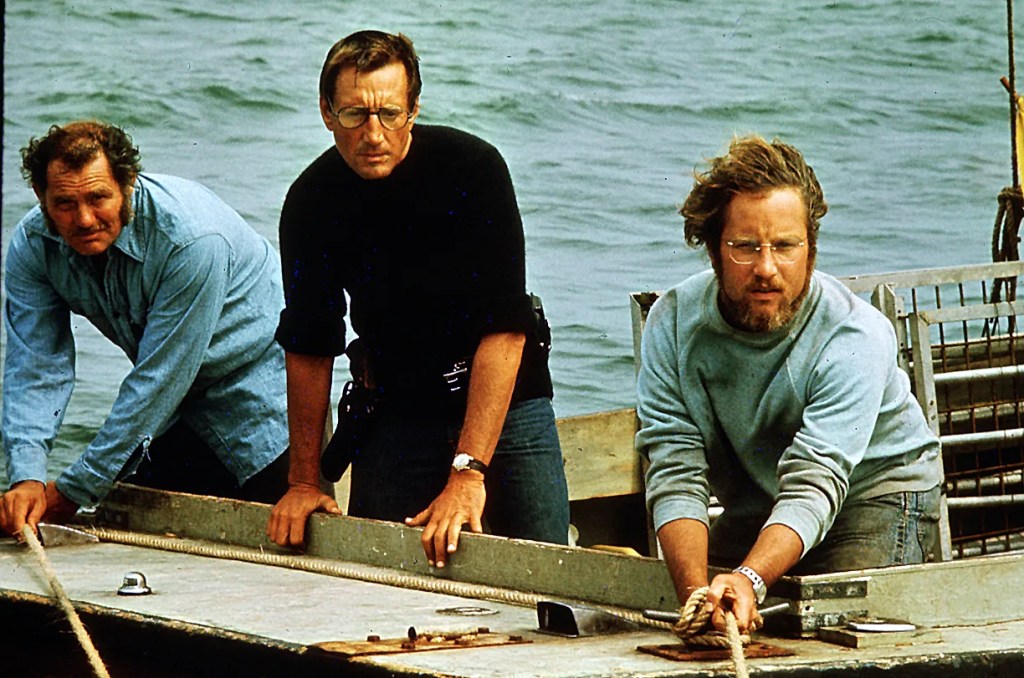

50 years have passed since Steven Spielberg ruined swimming, and we still can’t get enough of that pesky mechanical shark named Bruce. The sights, the sounds, the stories etc. We love “Jaws” for what it is, but also for what it’s come to represent as Hollywood’s first bona fide summer blockbuster.
Despite being released in the shadow of Vietnam and Watergate, the script is apolitical outside of the obvious commentary on Mayor Vaughn’s desire to place profit ahead of people, and the audience is better off. Spielberg’s goal is simply to give people an experience they’ll never forget without worrying if the characters will be perceived as too white or masculine decades down the line.
Screenwriters Peter Benchley and Carl Gottlieb are telling a classic tale of man vs. nature that is easily relatable, and they do so through the eyes of three of the most memorable protagonists in the history of cinema: Martin Brody, Matt Hooper, and Quint.
Chief Brody (Roy Scheider) is a quintessential everyman for whom keeping Amity Island safe is his sworn duty, Matt Hooper (Richard Dreyfuss) is a book-smart oceanographer whose scientific acumen is bound to clash with the locals, and Quint (Robert Shaw) is a grizzled veteran of the seas whose obsession with killing the shark goes way beyond whatever financial reward he may get in return.
Three vastly different men coming together for a common goal is a scenario that transcends cinema and gives the audience a reason to care. These are regular guys struggling against the elements without a Deus ex machina to save them, which is exactly how people get things done in the real world.
The alleged tension between Dreyfuss and Shaw on set fuels the personality conflict between Hooper and Quint on screen, because the age-old debate between Kenntnis (experiential learning) and Wissenschaft (book learning) is palpable. Hooper is concerned about measuring the shark’s bite radius while Quint just wants to kill the whole damn thing. We sense that a degree of mutual respect might exist, but it isn’t until they compare scars while Quint recounts his experience on the USS Indianapolis that they truly understand each other.
As for Brody, he’s caught in the middle and the fact that he ends up killing the shark is the only way this story should end. He couldn’t tell the difference between a tiger shark or a thresher shark, but his particular set of skills made him the right man for the job.
That’s why “Jaws” matters after all these years and why its cultural imprint continues to grow.
Sure, I had seen the film countless times before catching the newly released print in 3D, but venturing out on a rainy Thursday evening with my son so that he could experience the greatness in a theater was altogether different.
When Spielberg said during the introduction that it would be like seeing it for the first time, he wasn’t kidding.

 Music N' Other Drugs
Leave a comment