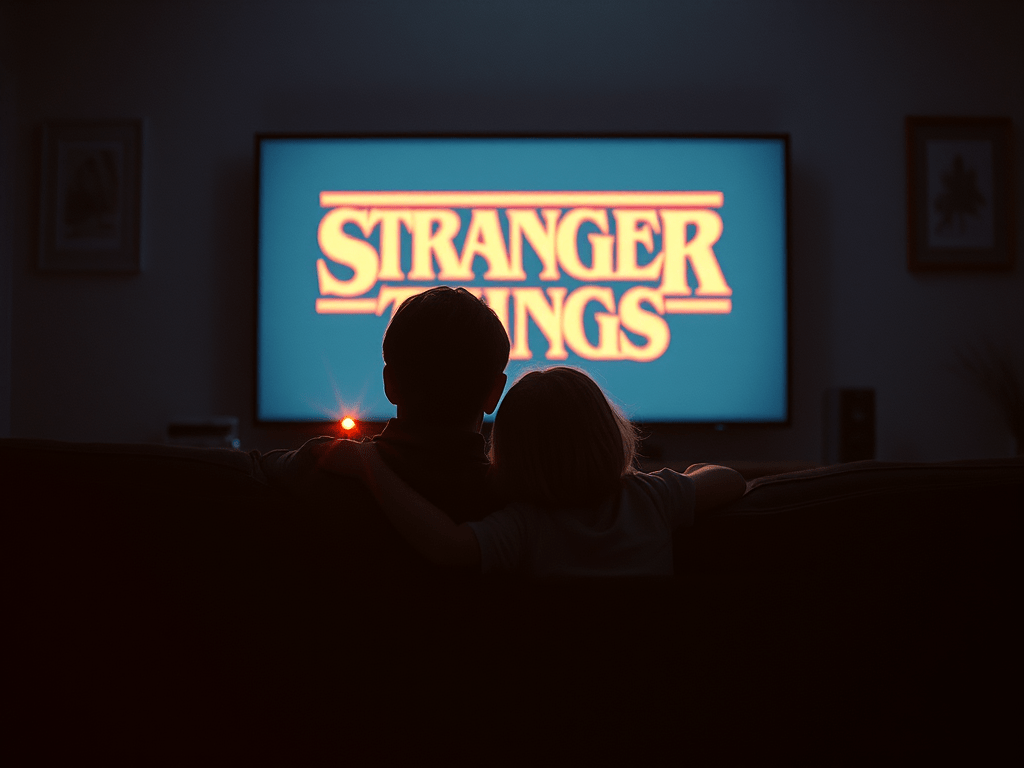
When the first season of “Stranger Things” dropped on July 15, 2016, I watched one episode and decided that the Duffer Brothers would be just fine without me. Perhaps it was the hype on social media, the underwhelming sterility of the pilot, or a combination of the two, but I didn’t see what everyone else saw. I wanted the second coming of “Twin Peaks” and what I got was a tween-friendly amalgamation of ideas best served by Steven Spielberg during the early days of the actual Reagan Administration as opposed to the one depicted within the show’s mythology.
But something happened near the end of 2025 where my 10-year-old son became obsessed with the show, and his enthusiasm inspired me to consume all 42 episodes in an attempt to converse about something beyond our usual back-and-forth banter. As parents, we’re well aware that there comes a time when our children move through adolescence and no longer want anything to do with us, so I’m not shy about admitting that I’ll seize any opportunity to bond until then.
One of the benefits of diving into the show a decade later was that I was unencumbered by expectations and able to formulate an opinion irrespective of what the fan community already spewed out over Instagram. I never followed the early seasons, so I experienced the show’s thrills, kills, and impeccable needle drops with a clean slate.
Now, do I think the hype was justified?
Well, that depends. What we learn about ourselves as we age is that certain subjects resonate more deeply than others based on what we’ve endured in our life up to that point.
For example, the disappearance of Will Byers hits harder when you have three children of your own as opposed to living a life free of parental responsibilities, but that’s part of what kept the narrative from descending into predictability.
If you’re a parent, you might have related to the struggle of Joyce, Hopper, and Karen. If you’re a kid trying to find your place within a hierarchy that doesn’t value what you bring to the table, you probably found the arc of Mike, Dustin, Will, Lucas, and Max to be exactly what you needed. And, if you’re caught between what you want to do and what the outside world thinks you should be doing, the character growth of Nancy, Jonathan, and Steve likely hit you harder than expected.
The Duffer Brothers borrowed from the greats of the past en route to crafting a nostalgia-heavy tale that offered a little something for everyone, which is why the debate regarding how the story ended continues.
As someone who will defend the finales of both “Seinfeld” and “The Sopranos” to the death, I found the conclusion of “Stranger Things” to be a divisive yet necessary lesson in why growing up sucks. It would have been easy to use the final two hours as a schmoozefest designed to give the fans exactly what they wanted, but the writers deserve credit for taking the road less traveled.
Eleven was the only thing keeping the group tethered to the supernatural world and her departure was symbolic of their transition into adulthood. Just as Kevin Arnold couldn’t have Winnie Cooper, Mike’s relationship with Eleven had to end. She had to leave so that they could all move on to the next chapter of their lives, so, when “Purple Rain” kicks in, the emotional wallop feels well-deserved.
Being an adult also means recognizing that the meeting between Nancy, Jonathan, Steve, and Robin on the WSQK rooftop will be their last despite everything that they’re saying to the contrary. They know it at the time, but sometimes we lie to ourselves to hide the truth about what’s really coming next. Dr. Ian Malcolm was right when he said that life finds a way, but it’s equally true that life gets in the way, and, given how all of their personalities evolved throughout the course of Chapter Five, the chances of their paths crossing again are slim.
In the end, the parallels between “Stranger Things” and “The Wonder Years” were too obvious to ignore. Both shows take place in a simpler time and are ultimately about the death of innocence for characters who clung to their childhood until the universe forced them to let it go. Once the campaign ends and the books go on the shelf, Mike, Dustin, Will, Lucas, and Max have accepted their fate, and we as the audience have no choice but to do the same.
How “Stranger Things” will be received by future generations is anyone’s guess, but I will say that having Sesame Street acknowledge your contributions to popular culture through parody is a pretty good indicator that you’ve done something right.

 Music N' Other Drugs
Leave a comment