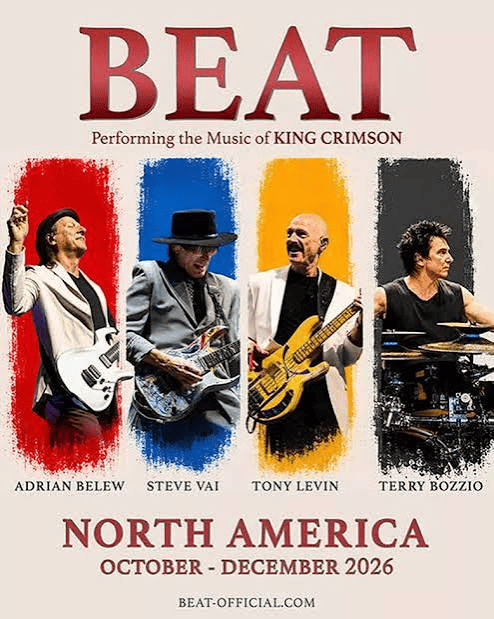

When Kendrick Lamar played the halftime show of the big game on Feb. 9, 2025, he made my job as a parent that much harder. You see, I had taken my nine-year-old son to experience BEAT on two separate occasions in late 2024 and he instantly took to the musical menagerie that is progressive rock.
Then, Lamar smiled at the camera, Serena Williams did a crip walk, and all my son wanted to listen to for the next six months was “Not Like Us.” As much as I loved 2015’s “To Pimp a Butterfly,” engaging in a schoolyard feud with Drake felt infantile and beneath someone widely regarded as the best rapper of his generation.
Now, with BEAT on the verge of making their return to the road with a new drummer in tow, it feels like the perfect time to rekindle the flame and get King Crimson back at the top of my son’s playlist. After all, “Discipline,” “Beat,” and “Three of a Perfect Pair” are among the coolest records you’ll ever hear and have aged better than most things to come out of the Reagan era.
I had the pleasure of speaking with Adrian Belew recently to preview the tour, and, if you missed them the last time around, don’t make that same mistake again.
MNOD: So, you guys are coming back to Rochester in November. When you first decided to get out on the road again, did you have any inkling that it would grow to the extent that the run is continuing two years later?
Belew: I really didn’t. I thought it would be good. We originally started with the idea of being able to do 40 shows and I thought that it would do well. The producers of the show weren’t so sure. And so, they said, ‘No, we’re going to put you in places that are a little smaller just to make sure that we do really well. It’s better to sell out than have a half empty bigger room.’ And then the tickets went on sale for the first show, and they sold out in three hours. So, then we ended up adding more shows and ultimately did 64 and they were sold out everywhere and there was really a lot of great stuff. So, at that point, when we finished the US tour, we sat down together the last night and said, ‘Okay, now what? Are we done or do we want to do something else?’ And we all four agreed, ‘Wow, this has been so great. We’ve got to do more. We want to tour the world.’ We decided then we wanted to do a world tour. And so that’s what’s been going on ever since. South America, then a little thing in Japan, and now 31 shows in Europe and back to the States. This will however be a stopping point, maybe forever, I don’t know. But next year, Steve Vai has a full schedule. I think Tony has a lot of things to do. I don’t know what Terry Bozzio will be doing then. Terry’s kind of new to this again. When I was trying to find the right drummer, the one thing, I thought of Terry several times, but I thought, where is he? I don’t even know what he’s doing these days. Nobody seemed to have heard from him for six years. He married a Japanese woman and lives in Japan. So that’s why it was a little weird to try to figure out whether or not we could do Terry, but it was something both Steve and Tony and I all three wanted to do because we’ve all played with him before.
MNOD: Yeah, I’ve been a big fan of Terry’s work for years, whether with Zappa or Missing Persons and stuff like that. Have you actually gotten together to rehearse with Terry yet?
Belew: No. This is the band’s main weak point. We can only get together for short periods of time when everyone’s calendar can suddenly line up. And so, we have never even had a day where we could sit and try to write music or anything. We have to just go straight into rehearsal, straight to the touring every time. So, we start rehearsals October 1st in LA, and then October 9th we have our first show. So, it’s a week of rehearsals, a day to get to Northern California and start the tour.
MNOD: What made Terry the right choice to fill in for Danny when Danny couldn’t commit to the tour?
Belew: Well, a couple of things. I called a lot of drummers. It was down to me to do that. And my criteria were a couple things. First of all, I thought it should be somebody who likes that music, not just a guy you can get because he’s a great drummer. And secondly, it should be someone who’s well known enough as Danny was to help fill the seats. That’s the great thing about having Steve and Danny in the band. They have their own audiences, and so that helps a lot. So I went through this list, Steve and I kind of compiled it, and for days on end, I was calling some of the most famous drummers in the world, and it was fun. To a man, they were all very surprised and very thankful to hear that we were offering them that opportunity. And also, to a man, they all had commitments because it was late in the season to come to. Any really great drummer would already be probably doing something. I mean, the one who really wanted to do it the most was Stewart Copeland, and he could have kicked himself because he only had two little commitments later, he could not get out of it all, and he really wanted to do it. But anyway, so it came down to the point where I went back to Steve and said, ‘Okay, let’s revisit this Terry Bozzio idea. Let’s figure out where he is and whether or not he’s even doing anything.’ And Steve took it from there. Next thing I knew, Steve talked to him, which I thought he should be the one talking to him because they had worked together longer than Terry and I had.
And then Terry said, ‘Absolutely, love to do it.’ Turns out he lives between Japan and LA, and he’s been playing all this time, and he really loves King Crimson. I knew that because he came to at least three or four of those shows back in the 80s, so that’s another reason I knew he had the right criteria.
MNOD: That’s really cool. I know you’ve discussed the possibility of adding some ’90s Crimson to the set, so how much of Thrak could we see?
Belew: Some. I’m not going to try to upset the apple cart with being more focused on the ’80s quartet, but I really did feel like you’re coming back to a place. A lot of people will maybe be saying to themselves, ‘I don’t know, I’ve seen this show. I loved it, but do I want to pay for that again?’ So, I felt like, well, there’s two things. First of all, you have a different show with Terry Bozzio. His interpretation will make it different. But secondly, I thought if we take out some of the material that I’m personally feeling like, yeah, I cannot play that one this time around and replace it with strong material from the ’90s, that would also be a reason for people to come to the show and a logical progression for the band. So, I don’t know how many we’ll get to. I’ve suggested three, maybe four, and we also have a surprise thing that we’re going to do, a surprise song, and most people probably will guess it, but it won’t be a surprise after the first night because everybody will know.
MNOD: What I loved about experiencing those three ’80s albums performed live in 2024 is that the material sounded just as fresh then as it did on the record. Did you feel that as you were going back through it?
Belew: That was exactly what I felt, and I was somewhat afraid that if I didn’t take the bull by the horns, that material would never have another hearing. It would be lost in the shuffle over the years. Robert had put together the previous King Crimson with the three drummers and all that, and they only played the early King Crimson for the most part, and not much of my era. So, I thought it’s really time for this. I listen to my audience, and I answer people on my Facebook page, and I know that they all say that’s their favorite era, and they all say, ‘Gee, we give anything to be able to experience that.’ Even the old people who hadn’t seen it say, ‘Yeah, wouldn’t that be great?’ But a lot of young people, because of social media, there’s a whole new audience waiting for it. So, I felt like it would do good, but more than that, I just felt like I wouldn’t want to leave that as something I didn’t do. I could do it, so I should try to do it. But the only way I felt I could do it is to have a very, very high caliber band, as high of a caliber as King Crimson is. So that was the problem. It took me five years to solve. Worth every moment though.
MNOD: I saw the Rochester show in October of ’24 with my son, and then I took him back again when you guys came to Buffalo in December of ’24. We could definitely tell that the band got even tighter as the tour went along just between those two shows.
Belew: Yeah, it’s interesting. When we started, I would say the sixth show, number six, I felt like now we are a band. Now we’re not perfect yet, but we’re finally sounding like a band, not like people trying to do someone else’s songs. And ever since then, we’ve done over a hundred shows. It’s never gotten less than that. We just did 31 shows in Europe, 21 countries. It was not an easy tour, a lot of travel, one after another, and every show was pretty much perfect. I felt like we kept congratulating. We’d come after the show and go, ‘Well, that was a great one, wasn’t it?’ And then the next night, ‘Well, that was a great one, wasn’t it?’ So, you get to a level with this kind of musicianship where probably after the first couple of shows, I would say we’ll be back to that position pretty quickly, and the rest of this tour should be just completely high caliber.
MNOD: There’s an intensity and a complexity to those three albums. What was the most difficult part for you in terms of getting this stuff down again?
Belew: Some of the picking stuff that is done on those records, the stuff that Robert and I did as a duet, I don’t play that style myself. It’s not my style. I have a looser style, and I don’t have a discipline like Robert does. You have to hold your pick this way and you play this way and you rehearse to a metronome two hours a day. That’s not me, but it’s great for him. So, there are a couple that really, I have to lock into. And you know what I did? I put two of them as the first two songs. I challenged myself even further. I said, ‘Okay, you’re going to go do two of the hardest ones first. Get that out of the way, and then you can relax a little bit.’ And I think we’ll still do those two as the beginning because it’s such a fierce beginning, especially if you aren’t expecting it. So, people who show up this time who are new will get the same feeling that you probably had.
MNOD: Yeah, definitely. Is there a particular song or solo that has either grown on you or become less appealing through the years?
Belew: There is one song that I don’t enjoy as much. I hate to go to the negative here, but I tried really hard to make sure that I had some of the gear, the vintage gear, so I could make some of those guitar synth sounds that were important to that era. And it sort of backfired on me because that gear is really hard. It’s hard to get anything out of now for me. So, there’s a section, I think it’s in Sheltering Sky, right before Steve plays his magnificent solo where I play a synth solo and every night, I feel like, gosh, I just can’t figure out something to make this work. It just doesn’t appeal to me anymore. It suddenly sounds very limited and very dated to me, but I’m still going to continue with that because I still have the commitment that that is part of that sound, but I sure wish that I could use something modern to do it with. But no, other places I feel great about. I mean, all of the stuff I do, really, I’m very pleased with. I am using my new gear for the most part and not trying for the most part to emulate exactly what I did then. And the reason is, I mean, it’s so many years later, I feel like I’ve got better things I can do. Although it is strange that I’ve not found anything that matches the solo that I did in Elephant Talk. Every time we get to Elephant Talk, I’m trying, what can I do that would top that one? It’s a pretty obtuse solo.
MNOD: Yeah, that was another one of my son’s favorite songs in the set.
Belew: It’s a great song though. I really enjoy playing it.
MNOD: Your voice was sounding excellent, as well, and I felt that you got stronger as the tour went along. Did you find that it was easy to sing that stuff again?
Belew: I’ve never stopped singing. Singing is a dear love of mine. So I learned in the last few years, I think back when I was doing the Bowie stuff, I learned my speaking voice could get raw. It even feeling kind of sounds that way to me right now. But my singing voice is in a different area of your vocal chords, a different register. So sometimes I would think, ‘Oh my, am I going to be able to sing those high notes now?’ And I would get out and they’d just be easy, just fine. I pride myself on being able to stay as much in tune as possible and hit every note every night. I mean, in 64 shows, I didn’t miss a beat ever. And it’s not something that people notice because they’re not at all 64 shows, but the guys in the band sure did. They said, ‘How did you do that?’ But it’s just something, if you’re a singer and you sing all the time, it’s like a muscle you keep in shape and it’s going to stay there. There are things you have to avoid. Lack of sleep or cigarettes or shouting or pot or anything that’s not good for your vocal cords, just stay away from that stuff because it’s easy to damage them.
MNOD: I also thought it was really cool that you guys put the live album out to capture the initial run. Did you have an idea of what shows you were going to release for that or was it a tough choice?
Belew: I think it’s all after the fact when you’re dealing with live stuff. I think we had three shows to choose from and you kind of go, well, maybe there’s something that you think we don’t really have a great one of this on any of the three shows. There’s also the limit to how much you want to put on something. With CDs, of course, you can fill them up a lot, but I felt the live material was pretty easy picking, really. Everything seemed to work out for the most part, but it is hard to do a live record. Myself, I’m not a real fan of live records because they never really sound as good as a studio recording. I mean, that’s just my thinking, but it’s two different things. So, I understand why someone likes to hear a live record and would say, ‘Yeah, check this out. I was at that show.’ I get that. And I thought it was great that we did the live records and the DVD because it could have easily gone by and slipped us, and then we wouldn’t have any record of that moment in time. So, I’m glad we do.
MNOD: One other thing that struck me about the shows was how great the sound was regardless of the venue. When I saw the Rochester show, my son and I were in the balcony and the sound was immaculate. And then when you guys came back to Buffalo, we sat right up in front, and it was just as good. How did you guys feel about the sound from show to show?
Belew: Well, we don’t really change anything. We are all wearing in ears and getting most of our sound, not from the stage, but from what we decide to have in the in ears. So that is really down to having a great professional sound man front of house guy. And we have changed to a different guy now, so I hope he does as well, and I bet he will though. The thing is, they need to study the music, and if you study the music of King Crimson, especially during that period, it becomes obvious the things that have to be a certain way. That’s what I said to Danny and Steve to begin with. There are essential things that have to be done a certain way to make this music. Beyond that, I said, ‘I want you guys to play your own way because I want to hear Steve Vai, I want to hear Danny Carey just like everybody else will.’ But there are guidelines. I’ll give you an example. When you’re playing the sort of Frame by Frame guitar stuff that Robert and I weave in and out, you have to have the same sound, you have to be at the same level together. If that’s not happening, it sounds really odd because you’re not getting the whole picture. It’s like you’re just not hearing the whole thing. So, it’s stuff like that. It’s not rocket science.
MNOD: I thought it was cool that you guys included Red in the set the last time around. Is that something you’re going to leave in or is that going to be one that gets cut this time around?
Belew: I think that one’s going to take a break for us. I hate to say that, but you have to get rid of something. I have played that song thousands of times in my life, so maybe it’s just a break for me and Tony because we play that song every year at our camp and that’s 14 years right there. It’s such a great piece. I do really love the power aspect of it, and maybe we’ll see, but I’ve got something special I want to do in the place where it resides, which is the first song of the encore. I don’t know. There’s no rule says that we can’t play longer in most places. Sometimes they have a curfew.
MNOD: Thanks again for taking the time to talk. I really appreciate it. According to my records, we last spoke in 2014, so it had been a while.
Belew: Great. Well, let’s talk again in 2030. Are you bringing your son again this time?
MNOD: Yeah, he wants to come back again.
Belew: Oh, wonderful. That’s great. Does he play an instrument?
MNOD: He has a guitar, yeah. He’s just learning.
Belew: Wonderful. Well, I hear a lot of young guitar players that blow my mind now. I don’t follow anybody, but just in looking through things, I suddenly see some kid who’s six years old and can play better than me and Steve Vai, and you just go, ‘Wow, well, there’s hope because we old guys, we got a certain shelf life. We don’t know how long it is, but eventually we’ll have to pass it on.’
MNOD: With football season about to begin, the last thing I wanted to mention is that the name of my fantasy team is actually the Twang Bar Kings.
Belew: That’s nice. The Twang Bar Kings. Yeah. Well, thank you for doing that. It’s an interesting phrase. Twang bar was, when I was growing up, that’s what they called a tremolo arm on the guitar. Where I lived in Kentucky, that’s what it was called. I’ve learned eventually that that’s not what everyone thought of it as. There’s so many terms for it, really. All right. Well, I’ll let you go and have a good time. We’ll see you there.
BEAT returns to the Kodak Center in Rochester, NY on Nov. 11.
See https://www.beat-official.com or https://www.kodakcenter.com for details.



Leave a comment